

Commercial truck accidents can involve much more than a negligent driver or a trucking company. Behind many commercial shipments is an extensive transportation network involving freight brokers, shipping companies, logistics providers, warehouse operators, manufacturers, and other businesses responsible for moving products across the United States. Although these companies may never physically drive a truck, their decisions can sometimes contribute to dangerous transportation conditions that put motorists at risk.
For someone injured in a collision with a commercial truck, identifying the responsible parties can be one of the most challenging parts of pursuing compensation. The trucking company may own the vehicle and employ the driver, but another business might have selected the carrier, arranged the shipment, ignored serious safety concerns, or encouraged transportation practices that created unreasonable risks.
This raises an important legal question: Can you sue a freight broker or shipping company after a commercial truck accident?
The answer is yes, under certain circumstances. Freight brokers and shipping companies are not automatically responsible whenever a truck involved in a shipment causes an accident. However, they may face legal responsibility when their own negligent decisions, actions, or failures contribute to a collision and someone suffers injuries as a result.
A particularly important legal development occurred on May 14, 2026, when the United States Supreme Court decided Montgomery v. Caribe Transport II, LLC. The unanimous decision clarified that the Federal Aviation Administration Authorization Act does not preempt state-law negligent-hiring claims against freight brokers when those claims fall within the statute’s motor vehicle safety exception.
This decision has important implications for injured motorists throughout the country, including people pursuing commercial truck accident claims in Orange County, California.
Understanding how freight brokers, shippers, and trucking companies operate can help accident victims recognize when additional parties may need to be investigated and what evidence may support a personal injury claim.
Understanding the Difference Between a Freight Broker, Shipper, and Trucking Company
Before determining who may be liable for a commercial truck accident, it is important to understand the different businesses involved in freight transportation.
Although these companies frequently work together, their responsibilities are not identical. Each organization may have a different role in arranging, preparing, transporting, or delivering commercial shipments.
What Is a Freight Broker?
A freight broker is an intermediary that arranges transportation between a shipper and a motor carrier.
For example, a manufacturer in California may need to transport thousands of products to a distribution center in another state. Rather than contacting individual trucking companies, the manufacturer may hire a freight broker to find an available carrier, negotiate transportation arrangements, and coordinate the shipment.
The broker generally does not operate the truck or employ the driver. Instead, it connects the business that needs transportation with a motor carrier that can perform the delivery.
The Federal Motor Carrier Safety Administration (FMCSA) describes brokers as intermediaries that arrange transportation between shippers and motor carriers. Unlike motor carriers, brokers generally do not transport the freight themselves.
However, the fact that a broker does not operate a truck does not necessarily mean it can never be held responsible for an accident involving a carrier it selected.
If a freight broker negligently hires a carrier with serious safety problems, ignores significant warning signs, or fails to exercise reasonable care when arranging transportation, its conduct may become relevant to a personal injury lawsuit.
What Is a Shipper?
A shipper is generally the business or individual that provides goods for transportation.
Shippers may include manufacturers, wholesalers, retailers, distributors, construction suppliers, agricultural businesses, and other organizations that need products delivered.
A shipper may contract directly with a trucking company or use a freight broker to arrange transportation.
For example, a furniture manufacturer might hire a logistics company to coordinate deliveries throughout Southern California. The logistics company could select a motor carrier, while a separate warehouse handles the physical loading of the trailer.
If an accident occurs, the investigation may need to determine whether the shipper, broker, carrier, warehouse, or another participant contributed to the dangerous circumstances.
What Is a Motor Carrier?
A motor carrier is the business responsible for operating commercial vehicles to transport property or passengers.
The trucking company may own the tractor-trailer, lease the equipment, employ or contract with the driver, arrange maintenance, and establish operating procedures.
Motor carriers generally have substantial responsibilities involving driver qualifications, vehicle inspections, maintenance, hours of service, and compliance with applicable transportation regulations.
If a truck driver causes an accident while working for a motor carrier, the trucking company may face liability under applicable employment, agency, negligence, or other legal principles.
The important distinction is that a motor carrier operates the truck, while a freight broker arranges transportation and a shipper provides the goods.
These distinctions matter because a commercial truck accident may involve several businesses with different responsibilities.
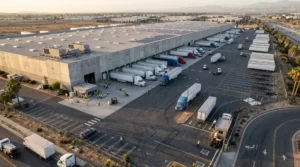 The 2026 Supreme Court Decision That Changed Freight Broker Liability
One of the most important developments in freight broker accident litigation is the United States Supreme Court’s decision in Montgomery v. Caribe Transport II, LLC, decided May 14, 2026.
The case addressed whether a freight broker could be sued under state negligence law for selecting an unsafe motor carrier.
The plaintiff, Shawn Montgomery, suffered severe and permanent injuries when a commercial truck operated by Caribe Transport struck his tractor-trailer. The shipment had been coordinated by C.H. Robinson Worldwide, a freight broker.
Montgomery alleged that the broker negligently selected the motor carrier despite information indicating that the carrier had significant safety problems.
According to the allegations discussed by the Supreme Court, the carrier had a conditional safety rating and deficiencies involving driver qualifications, hours of service, vehicle inspections, maintenance, and crash history.
The broker argued that the Federal Aviation Administration Authorization Act of 1994, commonly called the FAAAA, prevented the plaintiff from pursuing the state-law negligent-hiring claim.
The lower courts had accepted that argument, but the Supreme Court reversed.
What Did the Supreme Court Decide?
The Supreme Court unanimously held that the FAAAA’s motor vehicle safety exception protects state-law negligent-hiring claims against freight brokers when those claims concern motor vehicle safety.
The FAAAA generally restricts certain state laws related to the prices, routes, and services of motor carriers and brokers involved in transporting property.
However, the statute also contains an important exception preserving state authority over motor vehicle safety.
The Court concluded that a claim alleging that a broker negligently selected an unsafe trucking company concerns the motor vehicles that will be used to transport the shipment. Consequently, the safety exception can protect such a claim from federal preemption.
This means a freight broker cannot automatically defeat a negligent-hiring lawsuit simply by arguing that it is an intermediary rather than the company operating the truck.
The decision does not mean that every freight broker is liable after a collision. An injured person must still establish the applicable elements of negligence, including duty, breach, causation, and damages.
It also does not eliminate every possible preemption defense involving transportation services. The Supreme Court specifically explained that claims involving economic regulation unrelated to motor vehicle safety may remain subject to preemption.
The full decision can be reviewed in Montgomery v. Caribe Transport II, LLC, Supreme Court of the United States, May 14, 2026.
Why This Decision Matters to Truck Accident Victims
Before the decision, federal courts disagreed about whether certain negligent-hiring claims against freight brokers were blocked by federal transportation law.
That uncertainty sometimes made it difficult for injured people to pursue claims against brokers even when the selection of an unsafe carrier appeared to be a contributing factor.
The Supreme Court’s decision provides important nationwide clarification concerning the safety exception.
For accident victims, it means that an investigation does not necessarily have to stop with the driver and trucking company. The freight broker’s carrier-selection practices may also deserve examination.
For example, imagine a freight broker arranging a shipment with a motor carrier that has a history of serious safety violations. If the broker knew or reasonably should have discovered that the carrier presented significant safety risks, the selection decision could become relevant to a negligent-hiring claim after a crash.
The evidence must still establish that the broker’s conduct was negligent and that the negligence legally contributed to the injuries.
The decision therefore creates an important opportunity for appropriate claims, but it does not guarantee compensation.
When Can a Freight Broker Be Sued After a Truck Accident?
A freight broker may face liability when its own conduct creates or contributes to an unreasonable transportation safety risk.
One of the most important potential claims is negligent selection, sometimes discussed as negligent hiring.
Under this theory, the injured person generally argues that the broker failed to exercise reasonable care when selecting a motor carrier to transport goods.
The specific legal requirements depend on the applicable state law and the facts of the case.
Negligently Selecting an Unsafe Trucking Company
Freight brokers often have access to information about motor carriers before arranging transportation.
Depending on the available records and circumstances, this information may include federal safety ratings, inspection histories, registration information, insurance status, crash information, and other relevant safety indicators.
A broker that ignores significant warning signs may face questions about whether it exercised reasonable care.
For example, consider a logistics broker arranging a shipment from an Orange County distribution facility to a warehouse in Nevada.
The broker selects a carrier with a documented history of serious safety problems. Available records may show repeated inspection violations, problems involving driver qualifications, and a pattern of preventable crashes.
If the carrier’s truck later causes a collision because of an unsafe operating practice, investigators may examine what the broker knew or reasonably should have discovered when selecting that company.
The existence of a poor safety record alone does not automatically establish negligence. The legal analysis must consider the nature of the information, whether it was available at the relevant time, the broker’s responsibilities, and the connection between the alleged selection failure and the accident.
Nevertheless, the broker’s decision-making process can become important evidence.
Ignoring Serious Federal Safety Violations
Federal transportation safety regulations establish requirements designed to reduce the risk of commercial vehicle accidents.
A carrier’s safety history may reveal problems involving driver qualification, hours of service, vehicle maintenance, inspections, or other areas of compliance.
If a broker selects a carrier despite significant and relevant warning signs, the circumstances may support an argument that the broker failed to use reasonable care.
Investigators may examine whether the carrier had an unfavorable safety rating, whether its operating authority was active, whether its insurance requirements were satisfied, and whether other information suggested that the carrier was unsuitable for the shipment.
However, it is important to distinguish between a technical regulatory violation and evidence of negligent selection.
Not every violation makes a carrier unsafe for every shipment, and not every broker has the same knowledge or responsibilities under every arrangement.
The question is whether the broker acted reasonably under the circumstances and whether its conduct contributed to the accident.
Selecting a Carrier With an Unsafe Driver
In some circumstances, the problem may involve the individual driver rather than the trucking company as a whole.
A freight broker may arrange transportation through a carrier whose driver has serious qualification or safety problems.
For instance, a carrier may assign a driver who lacks appropriate qualifications, has a disqualifying driving history, or has not satisfied applicable requirements.
The broker’s potential responsibility will depend on the facts, the information reasonably available, and the legal duties applicable to its role.
An investigation may need to establish what the broker knew about the carrier, whether it had information about the driver’s qualifications, and whether its selection practices were reasonable.
The trucking company may also face separate liability for hiring, retaining, training, or supervising the driver.
Continuing to Use a Carrier Despite Repeated Safety Problems
Negligent selection is not always limited to the first time a broker works with a carrier.
A business may repeatedly arrange shipments with the same trucking company.
If serious safety concerns arise during that relationship, questions may develop about whether continuing to use the carrier was reasonable.
For example, a freight broker might receive information about repeated serious safety problems involving a particular carrier. If it continues arranging shipments without addressing those concerns, its subsequent decisions may become relevant to a negligence investigation.
The legal analysis depends on the broker’s knowledge, the timing of the information, the nature of the concerns, and the circumstances surrounding the later accident.
Can You Sue a Shipping Company After a Commercial Truck Accident?
The term shipping company can describe different types of businesses. It may refer to a shipper, freight forwarder, logistics provider, transportation broker, or another company involved in arranging deliveries.
Because these organizations perform different functions, their legal responsibilities must be evaluated separately.
A shipping company is not automatically responsible simply because its products were being transported when a collision occurred.
However, a company may face liability if its own negligent conduct contributed to the accident.
Negligent Selection of a Transportation Provider
A shipping company that directly selects a motor carrier may face questions about whether it exercised reasonable care in making that decision.
For example, a retailer may contract directly with a trucking company to transport products between warehouses.
If the retailer ignores serious information showing that the selected carrier presents an unreasonable safety risk, its selection process may become relevant to a negligence claim.
The 2026 Supreme Court decision specifically addressed freight broker negligent-hiring claims. Whether a particular shipper or other logistics business faces liability depends on its actual role and the legal theory involved.
Unsafe Delivery Schedules and Transportation Demands
Commercial deliveries often operate under strict deadlines.
A shipping company may establish delivery windows, coordinate appointments, or communicate expected arrival times.
Ordinary delivery scheduling does not automatically create liability when a truck driver causes an accident.
However, a company may become relevant if evidence shows that it knowingly created or encouraged unsafe transportation practices.
For example, a shipping company might impose unreasonable delivery expectations while knowing that meeting those expectations would require a driver or carrier to violate applicable safety requirements.
Investigators may examine communications, contracts, dispatch instructions, delivery deadlines, and the actual transportation arrangements.
The critical question is whether the company’s conduct breached a legal duty and contributed to the collision.
Improper Cargo Preparation or Loading
A shipping company may also be involved in preparing cargo for transportation.
If its employees or contractors improperly package, distribute, or secure freight, the resulting condition may create a dangerous situation.
For example, an improperly distributed load could affect the truck’s stability. Unsecured cargo could shift during braking or turning. Excessive weight could place additional stress on tires and braking systems.
The business responsible for the unsafe loading practice may become relevant to a personal injury investigation.
However, federal cargo-securement rules also impose important responsibilities on motor carriers and drivers. Responsibility should not be assigned automatically to the company that originally provided the shipment.
For a more detailed explanation of these issues, see the existing article on Cargo Loading Companies and Truck Accidents: When Can a Shipper Be Responsible?.
Negligent Control or Participation in Transportation Operations
A company may sometimes exercise more control over transportation activities than its business title suggests.
For example, a logistics provider might coordinate drivers, establish operational procedures, communicate instructions, or participate directly in decisions affecting the transportation process.
The existence of a contract describing a company as an independent intermediary does not necessarily resolve every question about its actual conduct.
Investigators may need to determine what the company actually controlled, what responsibilities it accepted, and whether its actions contributed to an unsafe situation.
The legal analysis must be based on the real relationship between the parties rather than simply the labels used in their agreements.
How Can You Prove a Freight Broker Was Negligent?
Proving a freight broker’s responsibility can require a detailed investigation because much of the relevant evidence may be held by companies that were not physically present at the accident scene.
Unlike a typical collision involving two passenger vehicles, a commercial truck accident may involve transportation contracts, carrier-selection records, electronic communications, federal safety information, and several layers of business relationships.
An injured person generally needs evidence supporting the applicable negligence claim.
Establishing a Duty of Reasonable Care
The first question is whether the freight broker owed a legally recognized duty under the circumstances.
In a negligent-selection case, the argument generally involves whether the broker was required to exercise reasonable care when selecting a carrier for transportation involving foreseeable risks of physical injury.
The Supreme Court’s 2026 decision recognized the role of ordinary state-law negligence principles in evaluating these claims.
However, the exact scope of a broker’s duty can depend on the applicable law, the relationship between the parties, and the specific conduct being challenged.
Demonstrating That the Broker Breached Its Duty
The next step is showing how the broker failed to exercise reasonable care.
Evidence might include records indicating that the carrier had serious safety problems, documents showing that relevant information was available before the shipment was arranged, or communications revealing that the broker disregarded significant warnings.
A broker may argue that it performed appropriate checks or that the carrier’s safety problems were unrelated to the collision.
Consequently, the investigation must examine the actual selection process and determine whether the broker’s conduct was reasonable.
Connecting the Broker’s Conduct to the Accident
Even if a broker made a questionable decision, that does not automatically establish liability.
The injured person must establish the required connection between the alleged negligence and the collision.
For example, suppose a broker selects a carrier with serious maintenance problems. A truck operated by that carrier later loses control because its brakes fail.
If evidence establishes that the broker’s negligent selection contributed to placing an unsafe carrier on the road and that the relevant safety problems caused the collision, the claim may have a stronger factual foundation.
By contrast, if the truck accident resulted from an unrelated event that had no connection to the alleged selection failure, proving causation could be more difficult.
Documenting Injuries and Financial Losses
A successful personal injury claim also requires evidence of legally recognized damages.
These may include medical expenses, lost income, reduced earning capacity, rehabilitation costs, and other financial losses.
Depending on the circumstances and applicable law, an injured person may also pursue compensation for pain, suffering, emotional distress, and loss of enjoyment of life.
Medical documentation, employment records, expert opinions, and other supporting evidence can help establish the extent of the harm.
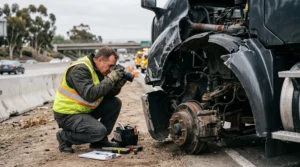 What Evidence Can Connect a Freight Broker to a Truck Accident?
Evidence is particularly important when investigating companies that arranged transportation but did not operate the vehicle.
The trucking company may possess information about the driver and truck, while the freight broker may hold separate records concerning carrier selection and shipment coordination.
A complete investigation may require information from both organizations.
Freight Broker and Carrier Selection Records
Carrier-selection documents may show how the broker chose the motor carrier.
These records could include applications, onboarding documents, safety reviews, carrier qualification files, insurance verification, and communications concerning the carrier’s operating status.
Investigators may also examine whether the broker performed safety checks before assigning the shipment.
The timing of these records is important. Information obtained after an accident cannot necessarily establish what the broker knew before the collision.
Federal Safety and Inspection Records
Federal safety information may help establish the condition of a motor carrier before the accident.
Depending on the circumstances, investigators may examine:
- Federal Motor Carrier Safety Administration registration information.
- Available safety ratings and compliance records.
- Inspection and out-of-service information.
- Driver qualification records maintained by the carrier.
- Hours-of-service compliance information.
- Available crash history.
- Maintenance and vehicle inspection documentation.
These records may help determine whether the carrier presented identifiable safety concerns when the broker selected it.
They must be interpreted carefully because a single inspection violation or safety record does not automatically establish that a carrier was unfit or that a broker acted negligently.
Contracts and Shipping Documents
Transportation contracts can reveal the relationship between the broker, shipper, and motor carrier.
Important documents may include broker-carrier agreements, shipping contracts, bills of lading, rate confirmations, delivery instructions, and other shipment records.
These materials may identify the businesses involved and describe their respective responsibilities.
They can also help establish which company selected the carrier, which organization controlled the delivery arrangements, and whether particular safety obligations were assigned or accepted.
However, contractual language does not necessarily determine every issue of civil liability. A court may need to examine the actual conduct of the parties as well as their written agreements.
Emails, Text Messages, and Dispatch Communications
Electronic communications may provide valuable evidence about what companies knew and when they knew it.
For example, a broker may have received warnings about a carrier’s safety history before assigning a shipment.
A shipping company may have communicated delivery requirements that become relevant to questions about scheduling pressure.
Dispatch records may also reveal whether a carrier was asked to complete a delivery within an unreasonable period.
These communications should be evaluated in context. A message discussing a delivery deadline does not, by itself, prove that a company encouraged unsafe driving.
Nevertheless, communications can help reconstruct the decisions leading up to the collision.
Truck Electronic Data and Accident Reconstruction
Vehicle electronic data may help establish the truck’s speed, braking activity, and movements immediately before the accident.
GPS information, electronic logging device records, surveillance footage, and other available data may also provide useful information.
An accident reconstruction specialist may compare this information with physical evidence, roadway conditions, vehicle damage, and witness accounts.
The goal is to establish what caused the collision and whether the alleged negligence of a broker or another business contributed to the events.
For additional guidance on evidence preservation and fault investigation, readers can review How to Prove Fault in an Orange County Truck Accident Case.
Can Multiple Companies Be Held Responsible for One Truck Accident?
Yes. A commercial truck accident can involve several potentially responsible parties.
The driver, motor carrier, freight broker, shipper, warehouse operator, maintenance provider, and other businesses may have played different roles in the events leading to the collision.
However, each party’s liability must be supported by evidence and an appropriate legal theory.
The Truck Driver
A driver may be responsible when negligent driving causes a collision.
Examples include speeding, distracted driving, unsafe lane changes, following too closely, driving while fatigued, or failing to respond appropriately to traffic conditions.
The driver may be personally liable for injuries caused by negligent conduct.
The Trucking Company
The motor carrier may face responsibility for its own negligence or, where applicable, for the conduct of employees acting within the scope of their employment.
Potential issues include negligent hiring, inadequate training, poor supervision, improper scheduling, and failure to maintain vehicles.
A trucking company may also have responsibility for regulatory violations that contributed to the crash.
The Freight Broker
A freight broker may face a negligent-selection claim if it failed to exercise reasonable care in choosing an unsafe carrier.
The Supreme Court’s 2026 Montgomery decision is especially relevant to this type of claim because it clarified the application of the FAAAA safety exception.
The Shipper or Warehouse Operator
A shipper or warehouse operator may become relevant if its own conduct created an unsafe cargo condition, contributed to an unreasonable transportation arrangement, or otherwise caused or contributed to the accident.
For example, improperly loaded cargo may contribute to a truck rollover or loss of control.
Other Transportation Businesses
A separate logistics provider, freight forwarder, maintenance contractor, equipment manufacturer, or another business may also require investigation when its conduct contributed to the collision.
Identifying every potentially responsible party is important, but the purpose is not to add defendants without justification.
The goal is to determine which businesses actually contributed to the accident and whether their conduct creates a valid legal claim.
How California Law Applies to Freight Broker and Shipping Company Liability
For people injured in Orange County, California law may play an important role in determining whether a freight broker or shipping company can be held responsible.
The Supreme Court’s Montgomery decision addresses federal preemption, but it does not replace the underlying state-law requirements for negligence.
California negligence principles generally require an injured person to establish a legally recognized duty, a breach of that duty, causation, and damages.
California Negligence Principles
A business may face liability when it fails to use reasonable care under circumstances where the law recognizes a duty to protect others from foreseeable harm.
In a freight broker case, the investigation may examine the carrier-selection process and whether the broker disregarded significant safety concerns.
In a shipping company case, the investigation may focus on the company’s own actions, such as unsafe cargo preparation, negligent transportation arrangements, or other conduct contributing to the accident.
Not every business involved in a shipment owes the same duties.
The facts and applicable law determine whether a particular company may be held responsible.
California’s Comparative Negligence Rules
California follows a pure comparative negligence system.
This means that an injured person may generally recover damages even if that person was partially responsible for the accident, although the recovery may be reduced according to the person’s percentage of fault.
For example, imagine that a jury determines an injured motorist suffered $500,000 in damages and was 20% responsible for the collision.
Under comparative negligence principles, the motorist’s recovery would generally be reduced by 20%, leaving $400,000 before considering other applicable legal issues.
When several businesses contribute to a commercial truck accident, the allocation of responsibility can become more complicated.
California also distinguishes between economic and non-economic damages when allocating responsibility among multiple defendants under its applicable liability rules.
The precise result depends on the legal claims, evidence, and circumstances of the case.
California’s Personal Injury Filing Deadline
Time limits are another important consideration.
Under California Code of Civil Procedure Section 335.1, many personal injury lawsuits must generally be filed within two years of the date the cause of action accrued.
However, special rules may apply in certain circumstances, including cases involving government entities, minors, or other legally recognized exceptions.
An injured person should not assume that every truck accident claim automatically has the same deadline.
Claims involving freight brokers and shipping companies can also require additional investigation because identifying the relevant businesses and preserving their records may take time.
Waiting too long can make it harder to obtain evidence and may jeopardize the ability to pursue compensation.
Federal and California Trucking Regulations
Federal motor carrier regulations may provide important evidence in a California truck accident investigation.
These regulations address driver qualifications, vehicle inspections, hours of service, maintenance, cargo securement, and other safety issues.
California also has state-specific requirements that may apply depending on the type of vehicle and transportation activity.
A regulatory violation does not automatically establish that a broker or shipper is liable. The investigation must determine which company had the relevant responsibility, whether a violation occurred, and whether the violation contributed to the accident.
For a broader explanation, readers can visit the existing article What You Should Know About Trucking Regulations in Orange County.
What Compensation Can You Recover After a Truck Accident Involving a Freight Broker?
When a freight broker or shipping company is legally responsible for injuries caused by a commercial truck accident, the injured person may be able to pursue compensation under the applicable personal injury laws.
The amount and types of damages depend on the severity of the injuries, available evidence, applicable insurance coverage, and the legal responsibility of each defendant.
Medical Expenses
Medical expenses are often a substantial part of a serious truck accident claim.
An injured person may require emergency treatment, hospitalization, surgery, medication, rehabilitation, physical therapy, and long-term medical care.
Some injuries may require ongoing treatment long after the initial accident.
A claim may include qualifying past medical expenses and reasonably supported future medical costs.
Medical records, bills, treatment plans, and expert opinions can help establish these losses.
Lost Wages and Reduced Earning Capacity
A serious collision may prevent someone from returning to work temporarily or permanently.
Lost wages may include income missed during recovery.
If the injuries affect the person’s ability to perform their previous job or earn the same income in the future, a claim may also involve reduced earning capacity.
For example, a construction worker who suffers a serious spinal injury may be unable to return to physically demanding employment.
In some cases, vocational and economic experts may help evaluate the long-term financial impact.
Pain and Suffering
Depending on the circumstances and applicable law, injured victims may pursue non-economic damages.
These damages can address physical pain, emotional distress, inconvenience, and the loss of activities that previously formed part of everyday life.
A serious collision may affect a person’s ability to exercise, travel, care for family members, or participate in normal activities.
The evaluation of these damages depends on the evidence and the individual circumstances.
Long-Term Care and Rehabilitation
Some commercial truck accident injuries require extended medical support.
An injured person may need physical therapy, occupational therapy, mobility equipment, home modifications, or assistance with daily activities.
When future care is reasonably necessary, the projected costs may become part of the damages analysis.
Wrongful Death Damages
If a commercial truck accident results in a fatality, certain surviving family members or representatives may be able to pursue a wrongful death claim under applicable state law.
California wrongful death claims may involve compensation for qualifying losses suffered by eligible survivors.
A separate survival action may also be available in appropriate circumstances.
These claims have specific legal requirements and deadlines, so families should obtain advice about their circumstances promptly.
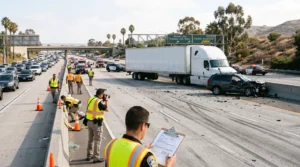 What Should You Do After a Commercial Truck Accident Involving a Freight Broker?
After a collision with a commercial truck, the first priority should always be safety and medical care.
However, certain steps may also help preserve evidence that could become important if the accident investigation identifies a freight broker or shipping company as a potentially responsible party.
Seek Medical Attention
Get emergency assistance when necessary and obtain a medical evaluation even if injuries initially appear minor.
Some injuries may not produce obvious symptoms immediately.
Following medical instructions and attending recommended appointments can also help create an accurate record of the injuries and treatment required.
Preserve Available Accident Evidence
When it is safe to do so, photographs and videos may help document the scene.
Useful images may include vehicle damage, the truck’s identifying information, trailer markings, road conditions, skid marks, debris, traffic signs, and the surrounding area.
Witness names and contact information may also become important.
Do not put yourself in danger to collect evidence, and do not interfere with the truck, its cargo, or any physical evidence.
Identify the Businesses Involved
The name displayed on the truck may identify the motor carrier, but it may not identify the freight broker, shipper, or logistics provider.
Shipping paperwork, bills of lading, delivery documents, and other available records may help establish which businesses participated in the transportation arrangement.
An investigation may also uncover companies that were not immediately visible at the accident scene.
Avoid Signing Unreviewed Settlement Agreements
After a serious truck accident, insurance representatives may contact injured people to discuss statements, claims, or settlement offers.
A quick payment may not account for future medical expenses, lost earning capacity, or other long-term losses.
Before accepting a settlement or signing a release, it is important to understand which parties are being released and what claims may be affected.
Obtain Legal Guidance Promptly
Commercial truck accident claims involving freight brokers can require specialized investigation.
A lawyer may need to identify the broker, obtain carrier-selection records, investigate the motor carrier’s safety history, preserve electronic evidence, and evaluate the applicable federal and California legal issues.
Early investigation can be particularly important because business records, surveillance footage, and electronic information may be subject to retention limits.
Common Defenses Freight Brokers and Shipping Companies May Raise
Freight brokers and shipping companies may dispute responsibility after a commercial truck accident.
Understanding the potential defenses can help explain why these claims require careful preparation.
Claiming the Broker Was Only an Intermediary
A freight broker may argue that it did not own the truck, employ the driver, or control the vehicle.
Although those facts may be relevant, they do not automatically defeat a negligent-selection claim.
The Supreme Court’s 2026 Montgomery decision clarified that state-law negligent-hiring claims involving motor vehicle safety can fall within the FAAAA’s safety exception.
The injured person must still establish the necessary elements of negligence.
Arguing That the Carrier Appeared Safe
A broker may argue that the motor carrier appeared qualified when the shipment was arranged.
It may point to registration records, insurance documents, safety reviews, or other information showing that it performed reasonable checks.
The investigation may therefore focus on what information was available at the relevant time and whether the broker’s selection process met the applicable standard of care.
Disputing Causation
A broker may argue that its carrier-selection decision had no connection to the actual cause of the accident.
For example, it may contend that the collision resulted from an unexpected roadway hazard or the independent negligence of another motorist.
Accident reconstruction, safety records, and expert analysis may be necessary to evaluate these arguments.
Blaming Another Driver or Business
A shipping company may argue that the motor carrier, driver, warehouse, or another business caused the collision.
In some cases, multiple parties may genuinely share responsibility.
California’s comparative negligence and allocation rules may affect how damages are evaluated.
The important issue is whether the evidence establishes each party’s actual contribution to the accident.
Why Freight Broker Truck Accident Cases Require a Thorough Investigation
Freight broker liability cases can be more complicated than ordinary commercial vehicle claims because the evidence is spread across several businesses.
The truck driver may have information about the accident itself, while the motor carrier holds employment and maintenance records. The freight broker may possess carrier-selection documents and shipment communications. The shipper may have delivery instructions and contracts.
These separate sources of information may need to be examined together.
A thorough investigation may also require reviewing federal safety records, identifying the precise transportation relationships, preserving electronic communications, and consulting experts.
In Orange County, commercial freight transportation connects warehouses, distribution centers, industrial facilities, retail businesses, and major transportation corridors. A shipment may pass through several companies before reaching its destination.
Consequently, identifying every relevant participant can be important when determining whether the driver and motor carrier were the only parties responsible for a collision.
The goal should be to establish liability through evidence rather than simply assume that every company involved in a shipment is legally responsible.
Frequently Asked Questions About Freight Broker and Shipping Company Liability
Can I sue a freight broker if the truck driver caused my accident?
Potentially, yes. A freight broker may face a negligent-selection claim if it failed to exercise reasonable care when choosing an unsafe motor carrier and that failure contributed to the accident. The Supreme Court’s 2026 Montgomery decision clarified that the FAAAA safety exception can protect these state-law claims from federal preemption.
Does a freight broker have to own the truck to be liable?
No. A freight broker does not generally need to own or operate the commercial truck to face a negligent-selection claim. The important issue is whether its own conduct breached an applicable legal duty and contributed to the injuries.
Can I sue both the trucking company and the freight broker?
Yes, if the evidence and applicable law support claims against both. The trucking company may be responsible for the driver’s conduct or its own safety failures, while the broker may face separate allegations involving negligent carrier selection.
Can a shipping company be responsible for an accident involving its products?
Possibly. Merely owning or shipping the products does not automatically create liability. However, a shipping company may face responsibility if its own conduct, such as negligent loading, unsafe transportation arrangements, or another actionable failure, contributed to the accident.
Does the 2026 Supreme Court decision apply in California?
The Supreme Court’s interpretation of the FAAAA safety exception is a nationwide federal ruling. It is relevant to qualifying negligent-hiring claims against freight brokers in California as well as other states. However, the underlying negligence requirements and other issues must still be evaluated under the applicable state law.
What if the freight broker says it had no control over the driver?
A broker’s lack of direct control over the driver does not automatically eliminate a negligent-selection claim. The relevant question may be whether the broker exercised reasonable care when selecting the motor carrier. Other theories of liability may require different evidence concerning control, agency, or the company’s actual conduct.
How long do I have to file a truck accident lawsuit in California?
Many California personal injury claims are subject to a general two-year statute of limitations under Code of Civil Procedure Section 335.1. However, exceptions and special deadlines may apply. Claims involving public entities, minors, and other circumstances can have different requirements.
What if several companies contributed to my truck accident?
More than one company may be legally responsible if the evidence establishes that each contributed to the accident through actionable negligence or another recognized legal basis. The driver, motor carrier, freight broker, shipper, warehouse operator, or another business may need to be investigated.
Can I still file a claim if I was partially responsible for the accident?
California generally follows pure comparative negligence. An injured person may still recover damages even if partially responsible, although the recovery is generally reduced according to that person’s percentage of fault.
Final Thoughts: Looking Beyond the Truck Driver After a Commercial Truck Accident
A commercial truck accident may involve a much larger transportation network than the vehicles visible at the accident scene.
Although truck drivers and motor carriers are often central to an investigation, freight brokers and shipping companies may also deserve scrutiny when their decisions or actions contributed to unsafe transportation conditions.
The May 2026 Supreme Court decision in Montgomery v. Caribe Transport II, LLC is an important development because it clarified that the FAAAA does not automatically prevent injured people from pursuing state-law negligent-hiring claims against freight brokers when the motor vehicle safety exception applies.
However, the ruling does not make brokers automatically liable. An injured person must still establish negligence, causation, and legally recognized damages under the applicable law.
For accident victims in Orange County and throughout California, identifying the full chain of responsibility may be an important part of understanding available legal options.
Evidence involving carrier-selection decisions, safety histories, shipping agreements, delivery instructions, electronic communications, and accident reconstruction may help establish whether another business contributed to a collision.
When a serious commercial truck accident occurs, the investigation should not necessarily stop with the driver or the company operating the vehicle. Examining the decisions made throughout the transportation process may reveal additional responsible parties and help injured people pursue the compensation available under the law.
Legal Disclaimer: This article is intended for general educational and informational purposes only. It does not constitute legal advice or create an attorney-client relationship. Truck accident liability depends on the facts of each case, applicable federal and state laws, available evidence, and procedural requirements. Anyone injured in a commercial truck accident should consider consulting a qualified attorney about the specific circumstances of the incident.