
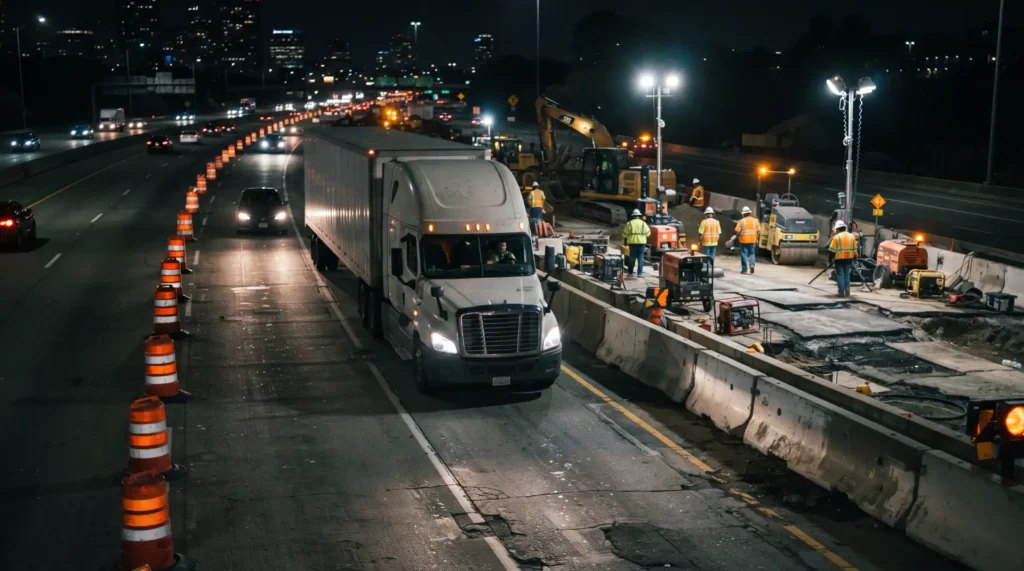
Work zone truck accidents may become especially serious because construction areas leave drivers less room to react. Lane shifts, reduced speeds, temporary barriers, congestion, and sudden stops may create additional challenges for large commercial trucks. These conditions matter on highways across the United States, especially along busy freight corridors.
Road construction is necessary for repairing, expanding, and improving American transportation infrastructure. However, a freeway under construction can operate very differently from the road drivers normally expect.
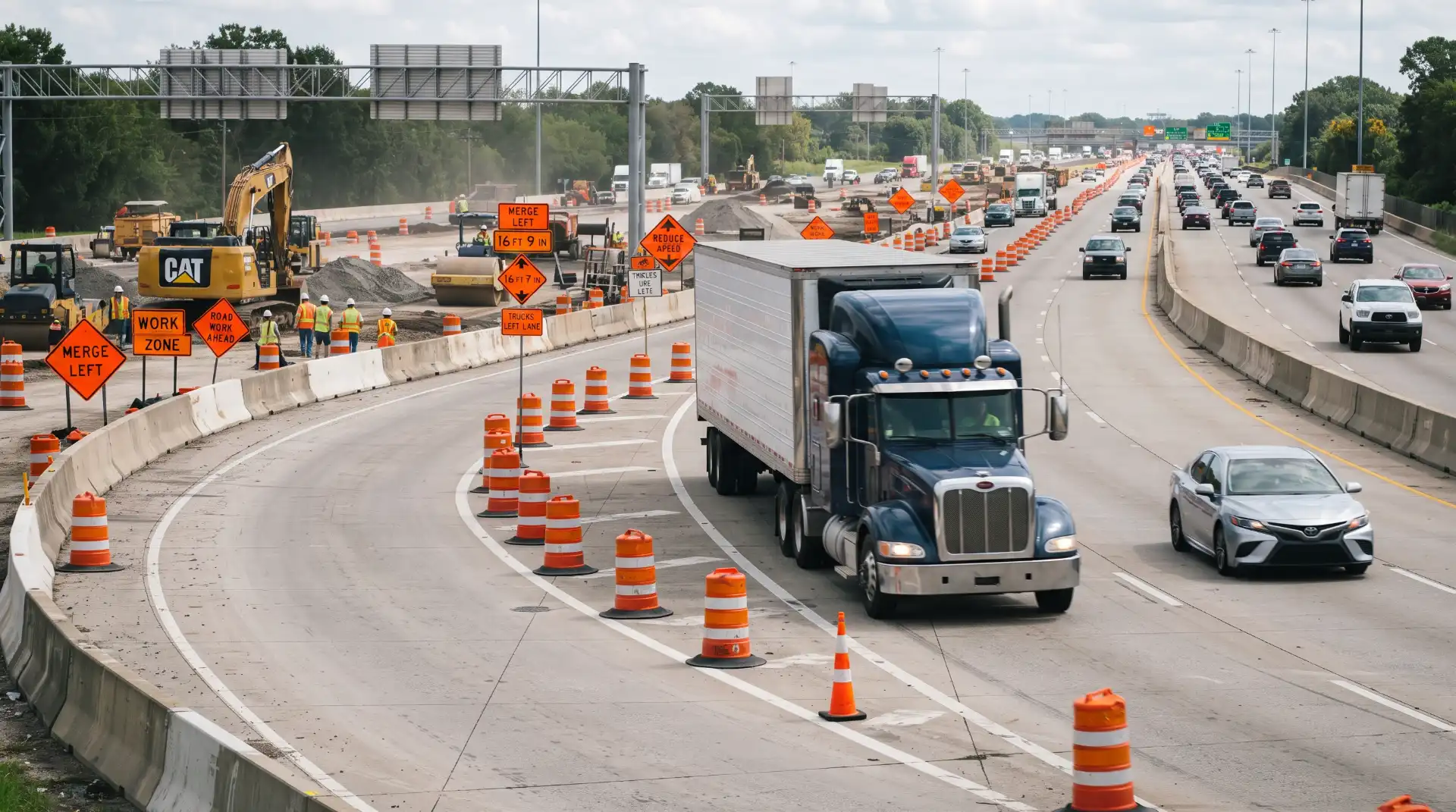
A familiar three-lane highway may suddenly become two narrow lanes. A shoulder may disappear behind concrete barriers. Traffic may merge unexpectedly. Speed limits may decrease several times within a short distance.
These changes affect every road user, but commercial trucks face additional challenges because of their size, weight, stopping distance, and turning requirements.
The Federal Highway Administration reports that work zones present safety and mobility risks because traffic patterns, available roadway space, construction activity, and other conditions may change frequently. Its 2026 National Work Zone Awareness Week data showed that large trucks or buses were involved in about 31 percent of fatal work-zone crashes in 2024.
Understanding why these crashes happen may help drivers recognize risks before entering a construction area.
Why Work Zones Create Different Driving Conditions
Most drivers become familiar with the roads they use regularly. They know where lanes merge, where traffic usually slows, and which exits require an early lane change.
Construction may temporarily change all of those expectations.
Work zones often contain temporary markings, reduced lane widths, concrete barriers, construction vehicles, uneven pavement, and shifting traffic patterns. Some areas change several times as a project progresses.
Drivers who passed through the same location one week earlier may encounter a different configuration during their next trip.
Commercial truck drivers must account for these changes while controlling vehicles that may weigh many times more than passenger cars.
A tractor trailer also needs considerably more space for braking and maneuvering. When construction reduces available space, even a small driving error may have serious consequences.
FHWA identifies daily traffic changes, narrowed roadways, and construction activity among the conditions associated with work-zone safety risks.
These factors may become more significant when several occur at the same time.
Narrow Lanes Leave Trucks Less Room to Maneuver
Lane width is one of the most noticeable changes in many freeway construction zones.
Temporary lanes may feel considerably narrower than normal freeway lanes. Concrete barriers sometimes run alongside traffic, leaving little space between vehicles and fixed objects.
This environment may be challenging for a large truck.
A tractor trailer occupies more lane space than a passenger vehicle. Small steering corrections can move the trailer closer to another lane or barrier. Curving temporary lanes may create additional difficulty.
Passenger vehicle drivers also sometimes hesitate while driving beside commercial trucks in narrow construction lanes.
A car that remains directly beside a trailer may enter an area where the truck driver has limited visibility. This situation may become more hazardous if traffic suddenly merges.
Truck drivers should account for the available space, surrounding vehicles, and temporary lane design when traveling through a work zone.
If a collision occurs, investigators may examine lane markings, vehicle positions, speed, traffic-control devices, and available roadway space.
Changing Lane Patterns May Increase Conflict Between Vehicles
Lane shifts are common during highway construction.
Transportation agencies may move traffic away from active work areas or close lanes temporarily. As a result, drivers may encounter unusual merges and temporary alignments.
A truck traveling in a lane that continues straight may suddenly need to move left or right.
At the same time, nearby passenger vehicles may also try to find the correct lane.
These simultaneous movements can create conflict.
Sideswipe crashes may occur when a commercial vehicle changes lanes without sufficient clearance. Passenger vehicles may also enter a truck’s blind spot while attempting to merge.
Drivers approaching construction areas should pay close attention to signs and pavement markings before reaching a lane closure.
Last-second lane changes may leave very little time for surrounding drivers to respond.
For more information about visibility around commercial vehicles, readers can review the site’s guide to truck accident causes and safety issues.
Sudden Congestion May Lead to Rear-End Truck Accidents
Traffic congestion is another major concern in freeway work zones.
A construction zone may reduce several lanes into one or two. Heavy traffic can quickly form behind the lane closure.
Drivers traveling at freeway speeds may encounter stopped traffic sooner than expected.
This situation is particularly concerning when large commercial vehicles are involved.
The FHWA reported that rear-end collisions accounted for nearly one-quarter of fatal work-zone crashes in 2024.
Heavy trucks require substantial distance to slow safely. Their stopping needs depend on speed, vehicle weight, road surface, brake condition, weather, and driver reaction time.
A truck driver who follows another vehicle too closely may have insufficient room when traffic suddenly stops.
Distraction may reduce available reaction time even further.
A driver who looks away from the road for several seconds may travel a significant distance before noticing congestion.
Rear-end truck collisions may cause severe damage because of the difference in vehicle size and mass.
Speed Changes Require Early Attention
Construction zones commonly contain reduced speed limits.
Drivers may encounter several signs before reaching active roadwork. Traffic itself may also require speeds far below the posted limit.
FHWA’s 2026 work-zone factsheet reported that speeding was a factor in more than one-third of fatal work-zone crashes during 2024.
Speed affects both stopping distance and the severity of a collision.
For a large commercial truck, the difference between recognizing slowing traffic early and recognizing it several seconds later may be significant.
Truck drivers also need to consider whether their current speed is appropriate for the actual conditions.
The posted speed may not always reflect congestion, rain, visibility, uneven pavement, or unusually narrow lanes.
Drivers entering a work zone should adjust to changing conditions rather than relying only on their usual freeway habits.
Construction Barriers Reduce Escape Space
Highways normally provide shoulders or open areas that may offer additional space during an emergency.
Work zones often eliminate that option.
Concrete barriers may run immediately alongside moving traffic. Temporary guardrails, construction vehicles, equipment, or excavated areas may occupy spaces that would normally remain open.
This limited escape space can affect both trucks and passenger vehicles.
If one driver suddenly enters another lane, surrounding motorists may have nowhere to move.
A commercial truck driver may also face difficulty avoiding a vehicle that stops or merges unexpectedly.
Barrier collisions can occur when drivers misjudge narrowed lanes or temporary curves.
Investigators examining these crashes may review photographs, road plans, construction configurations, pavement markings, and video evidence when available.
Nighttime Construction Adds Visibility Challenges
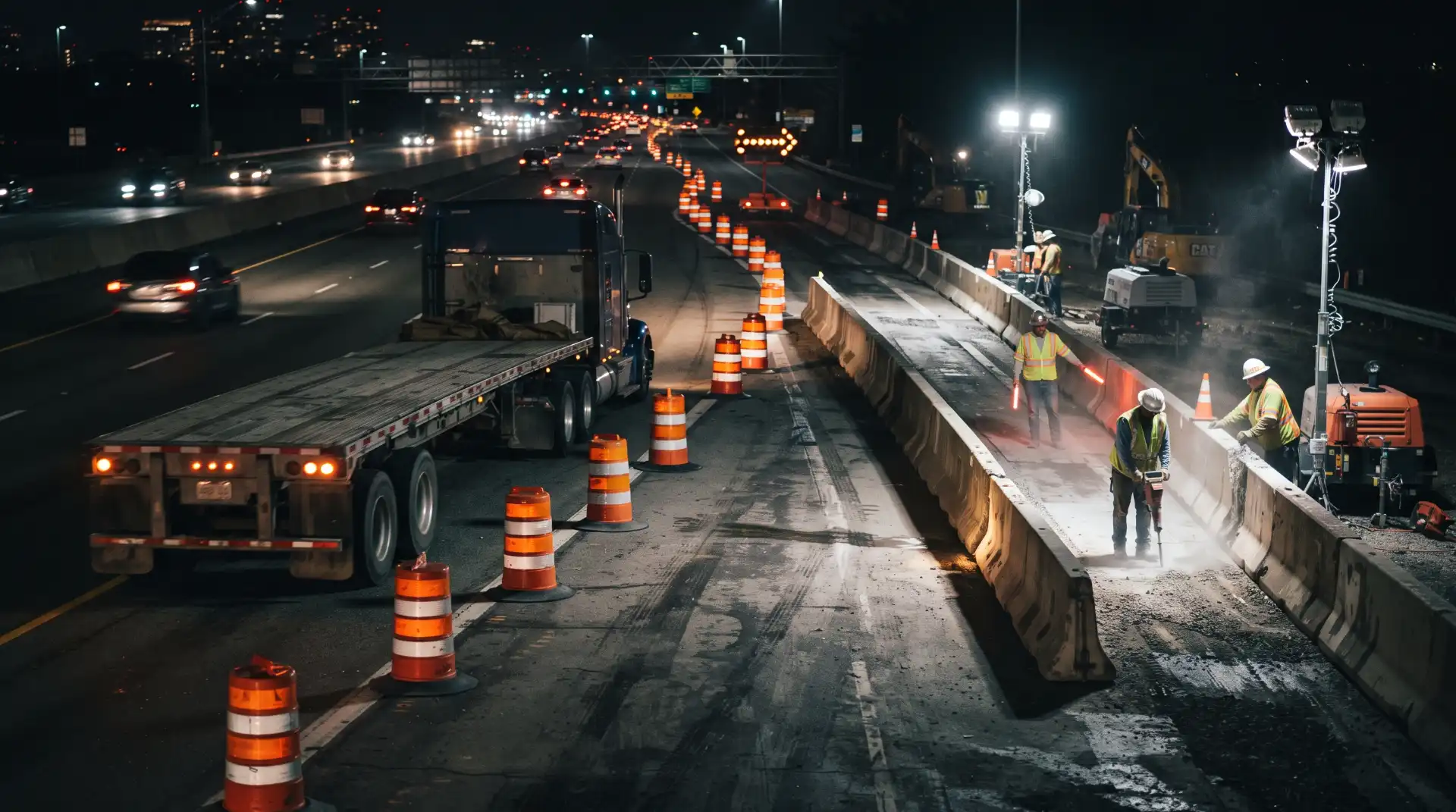
Many highway construction projects occur at night because traffic volumes may be lower.
Night work may reduce daytime congestion, but darkness creates different safety concerns.
FHWA reported that more than half of fatal work-zone crashes in 2024 occurred at night.
Temporary lighting may create glare. Construction equipment may cast unusual shadows. Reflective signs, flashing lights, and vehicle headlights may compete for a driver’s attention.
Lane markings may also be harder to interpret at night.
A commercial truck driver approaching a lane shift needs enough time to identify the new roadway path.
Rain, fog, or dirty windshields may reduce visibility further.
Drivers should remain alert for construction personnel, equipment, barriers, and vehicles entering or leaving active work areas.
Construction Vehicles May Enter Traffic Unexpectedly
Work zones contain vehicles that drivers do not normally encounter in regular freeway traffic.
Dump trucks, utility trucks, paving equipment, water trucks, maintenance vehicles, and other equipment may enter or leave the roadway.
Some vehicles accelerate more slowly than normal freeway traffic.
Others may stop near active lanes or travel short distances inside the construction area.
Commercial truck drivers need enough room to react when construction vehicles enter traffic.
Confusion may occur when temporary access points resemble open lanes or when construction equipment crosses traffic paths.
These incidents can become complicated because several organizations may participate in a highway project.
Depending on the circumstances, investigators may examine the actions of drivers, contractors, trucking companies, traffic-control personnel, or other involved parties.
Distracted Driving Becomes More Dangerous in Changing Conditions
A normal freeway requires constant attention.
A work zone may demand even greater concentration.
Drivers need to watch lane markings, construction signs, surrounding traffic, speed changes, barriers, workers, and equipment.
Distraction reduces the ability to process these conditions.
FHWA reported that distraction was involved in more than one in eight fatal work-zone crashes during 2024.
Commercial drivers may encounter potential distractions from navigation systems, dispatch messages, mobile devices, in-cab equipment, or other activities.
Even a brief distraction may matter when traffic patterns change quickly.
A collision investigation may examine electronic records, driver statements, onboard cameras, mobile-device information obtained through lawful procedures, and other evidence.
Readers interested in the broader role of evidence can also review How to Prove Fault in an Orange County Truck Accident Case.
Truck Blind Spots May Become More Significant During Lane Shifts
Large trucks have substantial areas around the vehicle where nearby cars may be difficult for the driver to see.
Construction zones can bring vehicles closer together.
Narrow lanes, reduced shoulders, and merging traffic may place passenger vehicles beside a truck for longer periods.
A driver who cannot see a nearby car may begin changing lanes into occupied space.
Passenger vehicle drivers may reduce their risk by avoiding prolonged travel directly beside a truck when conditions permit.
Truck drivers should also use mirrors carefully and account for surrounding traffic before changing lanes.
When a blind-spot collision occurs, investigators may examine vehicle positions, mirror configuration, camera footage, witness statements, and roadway design.
Fatigue May Affect Work-Zone Driving
Construction zones require rapid decision-making.
A tired driver may have slower reaction times and reduced attention.
Commercial drivers operate under federal hours-of-service rules intended to limit excessive driving periods. The Federal Motor Carrier Safety Administration regulates many aspects of commercial vehicle operations, including driver hours.
Your site’s existing article on trucking regulations in Orange County discusses hours-of-service rules and other commercial vehicle requirements.
Fatigue becomes especially concerning when a driver reaches unexpected congestion.
A fully alert driver may notice brake lights early and reduce speed gradually. A fatigued driver may recognize the hazard later.
Electronic logging information, dispatch records, fuel receipts, trip records, and other documents may help establish a driver’s schedule before a collision.
Weather May Make Temporary Road Conditions More Difficult
Rain, wind, fog, snow, and other weather conditions may increase work-zone risks.
Temporary pavement sometimes has different traction characteristics from permanent roadway surfaces.
Standing water may collect near barriers.
Old pavement markings may remain faintly visible after temporary lanes are created, which can confuse drivers during heavy rain.
Commercial vehicles may also react differently to strong winds, especially when trailers are lightly loaded or empty.
Drivers need to account for visibility, traction, traffic speed, and available stopping distance.
A crash that occurs during poor weather is not necessarily caused by weather alone.
Investigators may still examine vehicle speed, driver behavior, maintenance, roadway conditions, and other contributing factors.
Temporary Signs and Pavement Markings Matter
Work-zone traffic depends heavily on communication.
Signs warn drivers about lane closures, reduced speed, flaggers, detours, construction vehicles, and changing road conditions.
Temporary pavement markings guide traffic through unfamiliar routes.
When signs are difficult to see or markings become confusing, drivers may react unexpectedly.
One vehicle may suddenly change lanes after realizing that its lane ends.
Another may brake after missing an earlier warning.
Commercial truck drivers often need more advance notice because lane changes require additional space.
After a serious crash, the location and visibility of traffic-control devices may become part of the investigation.
Photographs taken near the time of the accident may help document the configuration that existed when the crash occurred.
Construction layouts may change afterward, making early documentation useful.
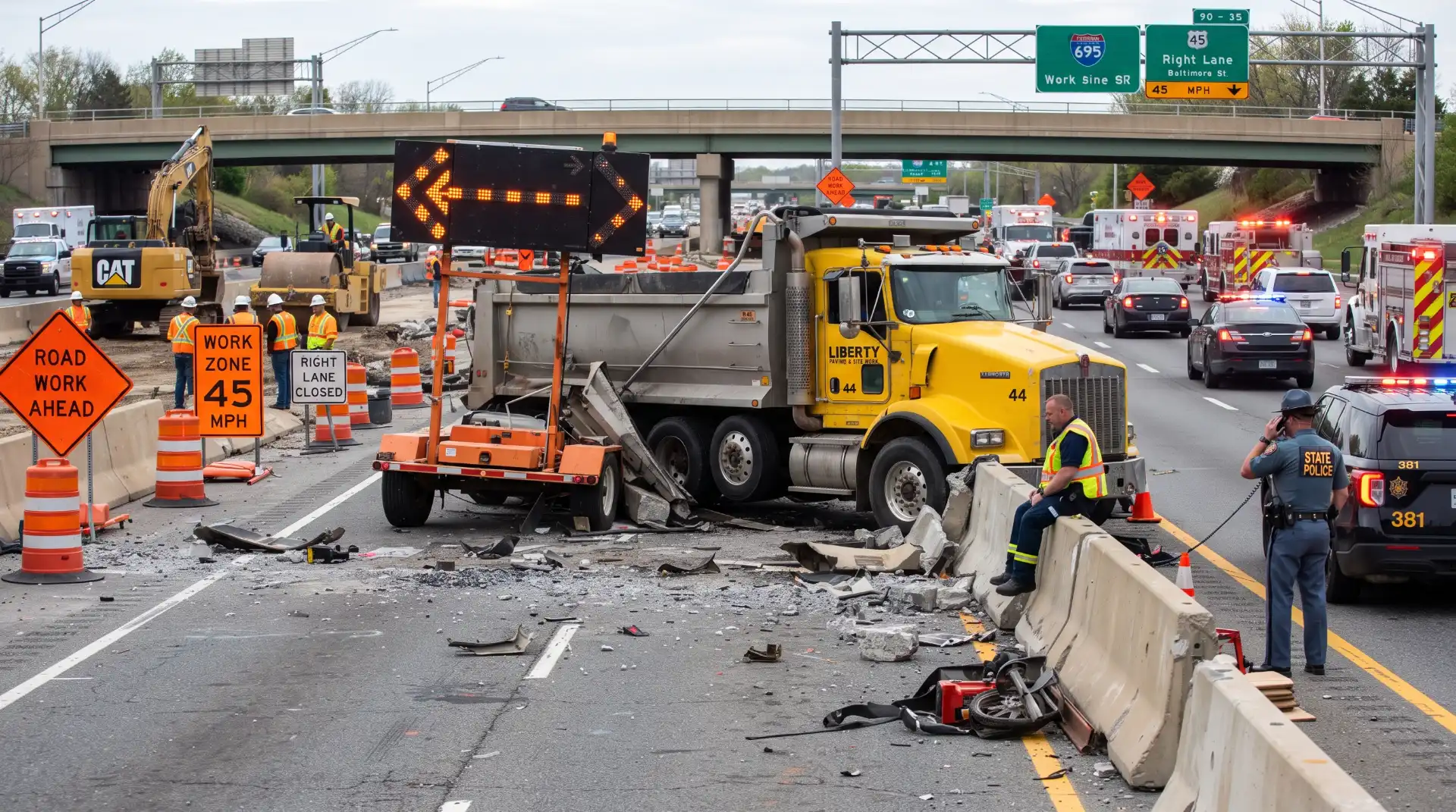
Who May Be Responsible for a Work Zone Truck Accident?
Responsibility depends on the facts surrounding each collision.
A truck driver may share responsibility if excessive speed, distraction, unsafe lane changes, following distance, or another driving action contributed to the crash.
A trucking company may become relevant when its policies, maintenance practices, training, scheduling, or regulatory compliance contributed to an unsafe situation.
Another motorist may also share responsibility.
Passenger vehicle drivers who cut directly in front of trucks, ignore closed lanes, or make unsafe movements may contribute to collisions.
Some cases may raise questions about construction contractors or other entities responsible for work-zone operations.
However, the presence of construction does not automatically mean the construction company or government agency bears responsibility.
Each potential party requires separate factual and legal analysis.
Readers can learn more about this issue in Understanding Liability in Orange County Truck Accidents.
Evidence That May Matter After a Work Zone Truck Crash
Work-zone accidents can involve unusually complex evidence.
The roadway configuration itself may change soon after the collision. A lane may reopen, barriers may move, or construction crews may advance to another phase.
For that reason, investigators often consider several forms of evidence.
Police reports may document vehicle positions and initial observations.
Photographs and video may show lanes, signs, barriers, road conditions, and vehicle damage.
Commercial trucks may contain electronic logging devices, GPS systems, dash cameras, engine control information, or collision-warning data.
Construction contractors may possess project records, traffic-control plans, surveillance footage, or documentation concerning lane closures.
Witness statements may also provide information about traffic conditions before the crash.
The relevance of each type of evidence depends on the circumstances.
Why Truck Accident Investigations May Be More Complex
A typical passenger vehicle crash often involves two drivers and their insurers.
Commercial truck crashes may involve several additional parties and records.
The driver may work for a carrier. The tractor and trailer may have different owners. Another company may have loaded the cargo. A maintenance contractor may service the truck.
A construction-zone collision can add additional organizations.
Contractors, subcontractors, transportation agencies, traffic-control companies, and equipment operators may participate in the project.
This does not mean every organization has legal responsibility.
It means investigators may need to understand the role each party played before determining which actions contributed to the crash.
Federal trucking rules may also become relevant.
For more information, see What You Should Know About Trucking Regulations in Orange County.
What Drivers Can Do When Approaching Work Zones
Work-zone safety depends on attention from every road user.
Drivers should begin watching for construction warnings before reaching the active work area.
Reducing speed gradually may give following vehicles more time to react.
Leaving additional following distance may also help when traffic stops unexpectedly.
Drivers should avoid unnecessary lane changes inside narrow construction areas.
Remaining outside a commercial truck’s blind spots may provide additional safety when traffic is merging.
Mobile phones and other distractions should remain secondary to the driving task.
These practices cannot prevent every crash, but they may reduce common work-zone risks.
Work-Zone Safety Is a National Transportation Issue
Road construction is part of maintaining the enormous U.S. highway network.
That means work-zone safety affects drivers in every state.
According to FHWA’s 2026 National Work Zone Awareness Week factsheet, 850 people died in work-zone crashes during 2024. Large trucks or buses were involved in 236 fatal work-zone crashes, representing about 31 percent of the total fatal work-zone crashes reported in that data.
These numbers show why commercial vehicle safety remains an important part of the broader work-zone discussion.
For current national information, statistics, training materials, and work-zone safety resources, visit the Federal Highway Administration Work Zone Management Program. FHWA provides guidance and data concerning construction-zone safety across the United States.
Understanding Work Zone Truck Accidents
Work zone truck accidents often involve more than one contributing factor.
Narrow lanes may combine with congestion. Congestion may combine with sudden braking. Reduced visibility may combine with unfamiliar lane shifts.
A commercial truck’s size and stopping requirements can make these conditions more challenging.
Understanding the complete sequence of events requires examination of the truck, driver, roadway, traffic controls, surrounding vehicles, and available electronic records.
The fact that a crash happened inside a construction zone does not automatically determine responsibility.
Instead, the evidence may show whether one or several actions contributed to the collision.
As road construction continues across U.S. highways, drivers and commercial carriers need to adapt to temporary conditions and changing traffic patterns.
Awareness, appropriate speed, following distance, and careful lane positioning remain important whenever large trucks and passenger vehicles share a restricted construction corridor.
For people involved in a serious commercial vehicle crash, reviewing the available evidence may help clarify what happened and which parties may bear responsibility under applicable law.