
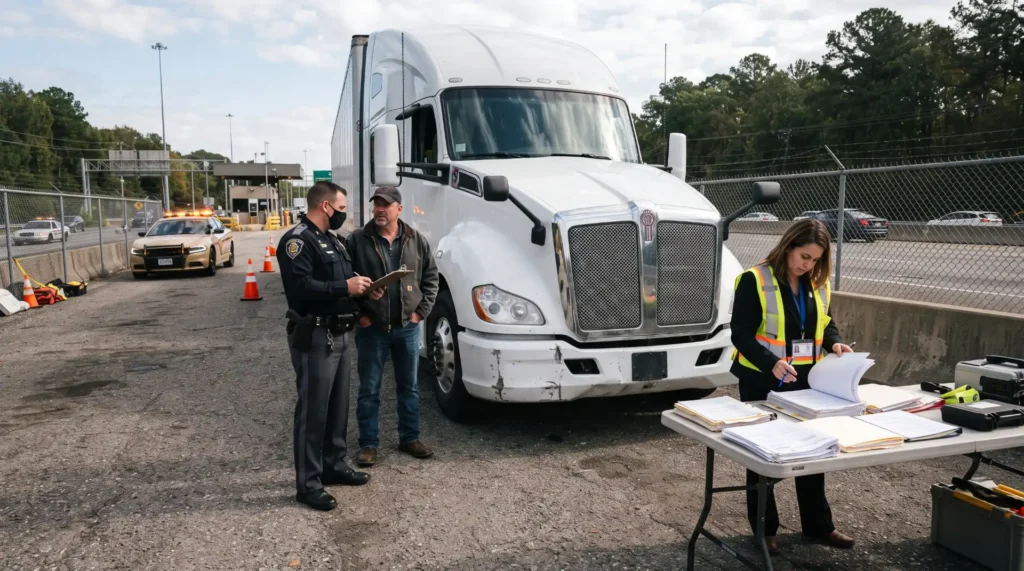
Truck driver drug and alcohol testing records may help show whether a commercial driver was impaired, whether a trucking company followed federal safety requirements, and whether warning signs were overlooked before a crash. However, a positive test does not automatically prove that impairment caused an accident. Attorneys generally compare testing records with driving behavior, video footage, electronic truck data, witness statements, medical evidence, and the circumstances of the collision.
Commercial truck drivers operate vehicles that may weigh many times more than ordinary passenger cars. Because an impaired driver may have difficulty maintaining a lane, responding to traffic, judging distance, or braking safely, federal regulations establish drug and alcohol testing requirements for many drivers who hold commercial driver’s licenses.
When a serious truck accident occurs, testing records can become an important part of the investigation. These records may show whether the driver was tested after the crash, whether the result was positive or negative, whether the driver refused testing, or whether the trucking company failed to follow required procedures. Historical records may also reveal earlier violations, return-to-duty requirements, or failures by an employer to check a driver’s eligibility.
Testing evidence must nevertheless be evaluated carefully. A test result may not identify exactly when a substance was used, and the presence of a substance does not always establish that the driver was impaired when the collision occurred. The timing of the test, the substance detected, the concentration, the collection procedure, and the driver’s behavior may all affect how much weight the evidence receives.
What Drug and Alcohol Testing Records May Exist?
A truck accident investigation may involve more than one laboratory report. Depending on the driver, employer, vehicle, and type of operation involved, relevant records may include pre-employment testing, random testing, reasonable-suspicion testing, post-accident testing, return-to-duty testing, and follow-up testing.
Pre-employment drug testing is intended to prevent a covered driver from performing safety-sensitive work until the employer receives an acceptable result. Random testing is conducted throughout the year according to federally regulated selection procedures. Reasonable-suspicion testing may occur when a properly trained supervisor observes specific signs suggesting possible drug use or alcohol misuse.
Post-accident records receive particular attention after a collision. They may include the testing order, collection time, alcohol-testing form, laboratory report, chain-of-custody documents, medical review officer communications, and explanations for any testing delay. Investigators may also request the employer’s written testing policy and records showing whether supervisors and drivers received required training.
Other potentially relevant documents include:
- Drug and Alcohol Clearinghouse query records.
- Prior positive tests or documented refusals.
- Substance abuse professional evaluations.
- Return-to-duty and follow-up testing records.
- Driver qualification and personnel files.
- Supervisor observations and incident reports.
- Employment applications and prior-employer inquiries.
- Documents identifying the collection facility and laboratory.
These records can help establish a timeline. For example, they may show when the collision occurred, when the driver received a citation, when the employer ordered testing, when the specimen was collected, and when the result was reported.

When Does Federal Law Require Post-Accident Testing?
Federal post-accident testing requirements do not apply after every commercial truck collision. Under 49 C.F.R. § 382.303, an employer must generally test a surviving covered commercial driver after an accident involving a fatality. Testing may also be required when the driver receives a qualifying moving-violation citation and the collision involves an injury requiring immediate treatment away from the scene or disabling vehicle damage requiring a tow.
For alcohol testing, the employer should administer the required test as soon as practicable. If testing does not occur within two hours, the employer must prepare and retain a record explaining the delay. The employer must stop attempting the test after eight hours and document why it was not completed.
For controlled-substance testing, the federal deadline is longer. If the required test is not completed within 32 hours, the employer must stop attempting to administer it and maintain a record explaining the delay.
These deadlines matter because alcohol and drugs may be metabolized or eliminated over time. A long delay may make it more difficult to determine whether a substance affected the driver at the time of the crash. A delay may also raise questions about whether the trucking company had adequate post-accident procedures.
However, the absence of a federally required test does not necessarily establish negligence. The crash may not have met the regulatory testing criteria. A moving-violation citation may not have been issued within the applicable period, or the driver may not have been covered by the federal testing program. Investigators must determine which rules applied before drawing conclusions.
How Testing Records May Affect a Truck Accident Lawsuit
Testing records can influence several issues in a personal injury or wrongful death lawsuit. They may help attorneys evaluate the driver’s conduct, the trucking company’s safety practices, the cause of the collision, and whether punitive damages should be investigated under applicable state law.
Evidence of Possible Driver Impairment
A properly administered alcohol test showing alcohol in the driver’s system shortly after a crash may support an argument that the driver’s perception, judgment, reaction time, or coordination was affected. A controlled-substance test may also be relevant, particularly when the result is consistent with witness observations or erratic driving recorded before the collision.
Testing evidence may be more persuasive when it is supported by additional facts, such as:
- Unsafe lane changes or unexplained drifting.
- Failure to brake despite visible traffic.
- Unusually slow or inconsistent speeds.
- Confused behavior or slurred speech.
- Open containers or suspected drugs found in the cab.
- Statements made by the driver at the scene.
- Dashcam footage or eyewitness observations.
By contrast, a test result standing alone may be open to several interpretations. The driver may dispute the collection process, argue that the substance did not cause impairment, or challenge whether the result is connected to the collision.

Evidence That the Trucking Company Violated Safety Duties
A trucking company may face scrutiny when its own records show that it allowed a driver to operate despite a known testing violation or prohibited status. Relevant questions may include whether the employer performed required pre-employment and annual Clearinghouse queries, removed the driver from safety-sensitive work, and confirmed completion of the return-to-duty process.
The Federal Motor Carrier Safety Administration’s Drug and Alcohol Clearinghouse is an online database that gives authorized employers and government agencies access to reported CDL-driver drug and alcohol program violations. It may contain positive results, refusals, and return-to-duty status information for covered drivers.
A driver with a prohibited Clearinghouse status may not lawfully operate a commercial motor vehicle until the required return-to-duty process is completed. Evidence that a carrier knowingly permitted a prohibited driver to continue operating may support claims involving negligent hiring, retention, supervision, or entrustment, depending on the facts and applicable law.
Related information about a motor carrier’s broader responsibilities may be discussed in the site’s guide to trucking company liability in truck accidents.
Evidence of Poor Company Policies or Enforcement
A carrier may have a written drug and alcohol policy but fail to enforce it consistently. For example, supervisors may ignore observable signs of impairment, fail to order reasonable-suspicion testing, or allow drivers to return to work before completing required steps.
Repeated procedural failures may suggest that the collision was not simply an isolated mistake by one driver. They may point to broader problems involving driver oversight, compliance training, dispatch pressure, or management practices.
Attorneys may compare the carrier’s written rules with its actual conduct. Training records, internal emails, disciplinary files, testing schedules, dispatch communications, and testimony from other employees can help show whether the company maintained a meaningful safety program or merely had policies on paper.
Evidence Relevant to Negligent Hiring or Retention
A carrier is expected to evaluate whether a driver is qualified to perform safety-sensitive work. If a company failed to conduct required inquiries or ignored disclosed violations, testing records may become relevant to whether the driver should have been hired, retained, or assigned to operate a commercial vehicle.
For example, a lawsuit may examine whether the employer:
- Completed a pre-employment Clearinghouse query.
- Investigated prior employment and safety history.
- Responded appropriately to a reported violation.
- Removed the driver from safety-sensitive work.
- Verified completion of return-to-duty requirements.
- Conducted required follow-up testing.
The legal significance of these facts depends on whether the omission contributed to the crash. A paperwork violation unrelated to the collision may carry less weight than evidence showing that a known impaired or prohibited driver was placed behind the wheel.
Why a Positive Test Does Not Automatically Prove Causation
A positive drug test can be important, but it does not automatically establish that drug use caused the truck accident. Some drug tests detect prior use without precisely showing whether the driver was impaired at the moment of impact.
Urine testing, for example, may reveal metabolites that remain after the immediate effects have ended. The detection period varies depending on the substance, amount used, frequency of use, metabolism, and other factors. A toxicology expert may be needed to explain what the result does and does not establish.
The same distinction can arise with legally prescribed medication. A prescription does not necessarily make commercial driving safe, but the presence of a medication does not automatically prove negligence. Investigators may need to determine the medication’s known effects, dosage, timing, warnings, and whether the driver’s medical provider knew that the person operated a commercial vehicle.
Alcohol evidence is often more time-sensitive because alcohol concentration may change significantly after the crash. The collection time, test method, calibration records, and any delay may therefore become central issues.
To connect a positive result to the collision, attorneys may consult toxicologists, medical experts, accident reconstruction specialists, or human-factors experts. These professionals may evaluate whether the detected substance could have affected reaction time, perception, decision-making, or motor control.
The site’s discussion of expert witnesses in truck accident cases explains how technical specialists may help jurors understand complicated evidence.
What Does a Refusal to Test Mean?
A refusal may be treated as a serious violation under federal commercial-driver testing rules. Refusal is not limited to verbally declining a test. Depending on the circumstances, it may include failing to appear, leaving before the process is completed, failing to provide an adequate specimen without a valid medical explanation, interfering with the collection, or failing to cooperate.
In a civil lawsuit, the parties may dispute why testing was not completed. The driver may argue that medical treatment, confusion, lack of notice, or another legitimate circumstance prevented compliance. The carrier may contend that it made reasonable efforts to arrange testing.
Records created at the time can be especially important. Collection-site notes, hospital records, phone logs, emails, dispatch communications, and witness testimony may show whether the driver intentionally avoided testing or whether circumstances outside the driver’s control caused the failure.
Can a Negative Test Defeat an Injury Claim?
A negative drug or alcohol result does not establish that the truck driver used reasonable care in every other respect. A driver may still cause a collision through fatigue, speeding, distraction, unsafe lane changes, poor judgment, or an hours-of-service violation.
A negative result may help eliminate one suspected cause, but the overall accident investigation should continue. Electronic logging device information, engine-control data, GPS history, dashcam footage, cell phone records, maintenance documents, cargo records, and witness accounts may reveal a different explanation.
Similarly, a negative test does not automatically relieve the trucking company of responsibility. The carrier may still be liable for inadequate training, negligent hiring, defective maintenance, unsafe scheduling, or another act that contributed to the crash.
Readers can learn more about identifying responsible parties in the site’s article on how to prove liability in an Orange County truck accident case.
Why Testing Delays and Missing Records Matter
A delayed test can reduce the evidence’s usefulness. It may also require the carrier to explain why testing was not administered within the federal time limits. Investigators may examine whether the employer had an established procedure, whether a testing facility was available, and whether the driver remained available.
Missing records may raise separate concerns. Testing and compliance documents may be stored by the carrier, a consortium or third-party administrator, a medical review officer, the collection site, or the laboratory. Each entity may have different records and retention responsibilities.
A missing document does not automatically prove misconduct. Records may have been retained by another entity, become unavailable through ordinary retention practices, or never existed because the test was not required. The investigation should determine what should have existed, who controlled it, and when the company received notice of the potential claim.
Once litigation is reasonably anticipated, the parties may be expected to preserve relevant evidence. An attorney may send a preservation letter requesting that the carrier retain testing records, electronic communications, driver files, truck data, videos, and other materials related to the collision.
Chain of Custody and Reliability Challenges
Drug and alcohol test results must be connected to the correct driver and handled according to required procedures. Chain-of-custody documents track the specimen from collection through laboratory analysis and reporting.
A challenge may arise if documents contain inconsistent identification numbers, missing signatures, unexplained gaps, broken seals, or incorrect collection times. The parties may also examine whether the testing device was calibrated, whether the laboratory followed required procedures, and whether the medical review officer properly evaluated the result.
Not every technical mistake makes a result unusable. Courts generally consider the nature of the problem, whether it affected reliability, and whether supporting evidence resolves the discrepancy. Expert testimony may be necessary when the parties disagree about the scientific or procedural significance of an error.
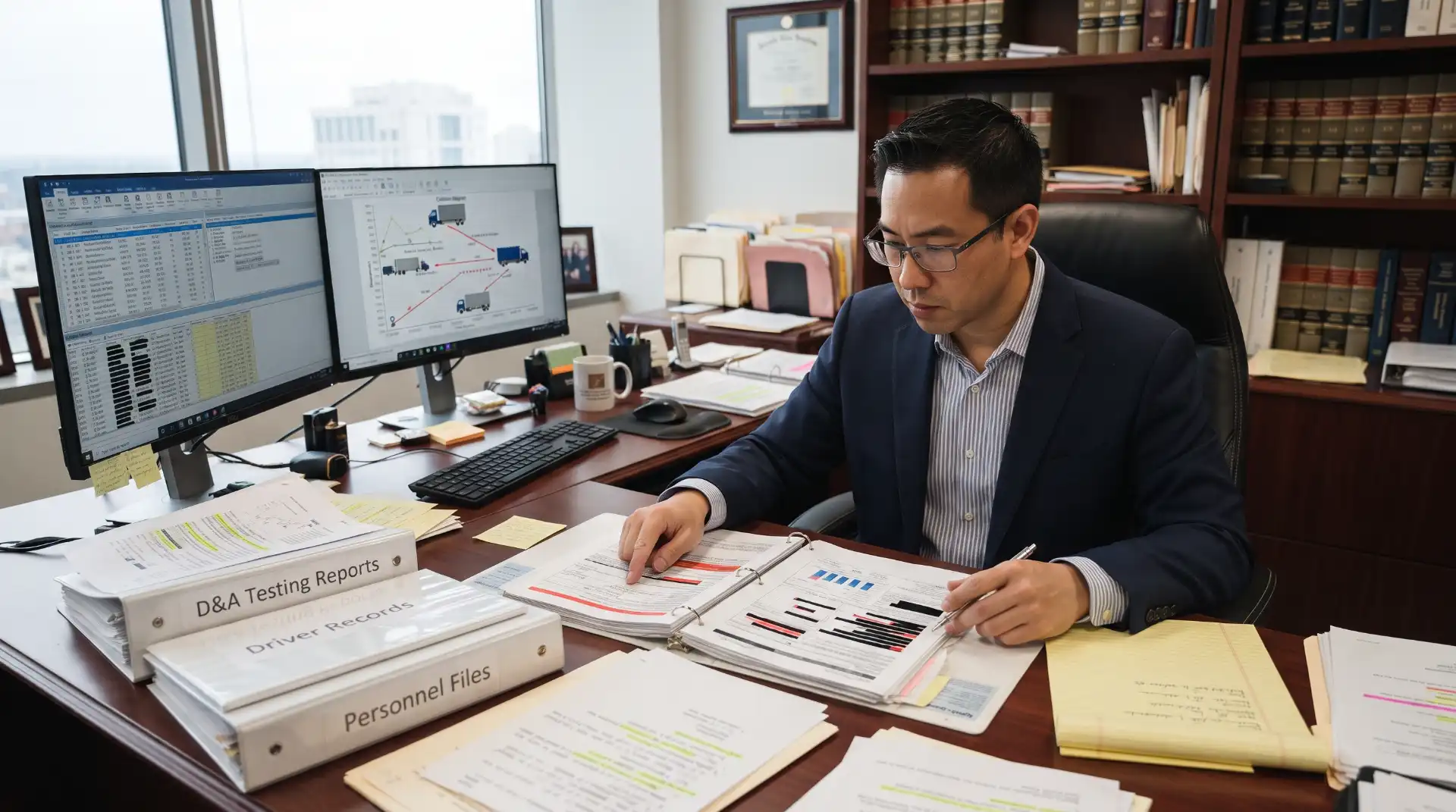
Testing Records Must Be Compared With Other Crash Evidence
A complete truck accident investigation does not focus exclusively on toxicology. Testing results are generally evaluated alongside evidence showing how the vehicles moved before impact.
Important supporting evidence may include police reports, traffic-camera footage, dashcam recordings, witness statements, physical damage, tire marks, electronic control module data, braking information, GPS records, dispatch messages, and cell phone activity.
Suppose a test detects a prohibited substance, but video shows that another vehicle suddenly entered the truck’s lane and left the driver no reasonable opportunity to avoid the collision. The test may still have regulatory consequences, but causation could remain disputed.
In another case, a positive result combined with prolonged drifting, delayed braking, witness observations, and driver admissions may create stronger evidence that impairment contributed to the crash.
California’s comparative-fault rules may also affect an Orange County lawsuit. More than one person or company can contribute to a collision, and the injured person’s compensation may be reduced by any percentage of fault attributed to that person. A positive truck driver test does not prevent defendants from arguing that another road user also contributed to the accident.
Could Testing Evidence Support Punitive Damages?
Punitive damages are intended to punish and deter especially wrongful conduct rather than compensate an injured person for ordinary losses. The requirements vary by state and are generally more demanding than the standard needed to prove negligence.
Evidence that a commercial driver knowingly operated a large truck while severely impaired may lead an attorney to investigate whether punitive damages are available. Evidence that a company knowingly allowed a repeatedly impaired or prohibited driver to continue operating could also receive scrutiny.
However, a positive test does not automatically justify punitive damages. The evidence generally must establish the required level of conscious, reckless, malicious, or oppressive conduct under the law governing the claim. Corporate punitive-damages claims may involve additional requirements concerning authorization, ratification, or conduct by managing personnel.
What Compensation May Be Available?
When impairment or negligent safety management contributes to a truck accident, an injured person may seek compensation for losses supported by the evidence and allowed by applicable law. Recoverable damages depend on the jurisdiction, the severity of the injuries, available insurance, and the facts of the case.
Potential damages may include emergency treatment, hospitalization, surgery, rehabilitation, medication, future medical care, lost income, reduced earning capacity, property damage, pain, emotional distress, and loss of enjoyment of life.
Families affected by a fatal truck crash may have separate wrongful death or survival claims. Those claims may address funeral expenses, lost financial support, loss of companionship, and other legally recognized losses.
Testing evidence may help establish liability, but it does not determine the value of a claim. Compensation must still be connected to documented injuries, expenses, income losses, and future consequences.
Steps to Take After a Suspected Impaired-Driving Truck Crash
Anyone injured in a commercial truck collision should prioritize medical care. Some injuries may not be immediately apparent, particularly when adrenaline masks pain at the scene. Medical records can also document the timing and extent of the injuries.
When it can be done safely, photographs or videos should capture vehicle positions, damage, skid marks, cargo, road conditions, traffic controls, and identifying information on the truck. Witness names and contact details can also be valuable.
Suspected impairment should be reported to the investigating officer, but injured parties should avoid confronting the truck driver. Police officers can document observations and determine whether separate law-enforcement testing is appropriate.
Because electronic and company records may be overwritten or lost, legal counsel may seek preservation of testing documents, Clearinghouse information, driver files, dispatch records, vehicle data, and camera footage. Guidance on immediate actions is also available in the site’s article about what to do after a truck accident in Orange County.
Frequently Asked Questions
Does every truck driver receive a drug and alcohol test after a crash?
No. Federal post-accident testing applies only when specific regulatory conditions are met. Fatal crashes generally trigger testing for surviving covered drivers, while certain injury and tow-away crashes may require testing when the commercial driver receives a qualifying moving-violation citation.
Can an injured person obtain the truck driver’s testing records?
Potentially. Some records may be obtained through formal discovery, subpoenas, authorizations, or court orders. Access may be limited by confidentiality rules, relevance requirements, and protections governing employment or medical information.
What if the trucking company failed to test the driver?
The legal effect depends on whether testing was required and why it was not completed. Failure to conduct a required test may support an argument that the company violated federal safety rules, but the injured party must still prove liability, causation, and damages.
Can a prior positive test be used in the lawsuit?
Possibly, but admissibility depends on relevance, timing, similarity, applicable evidence rules, and the purpose for which the record is offered. A prior violation may be more relevant to negligent hiring or retention than to proving impairment during the current crash.
Can legal marijuana use affect a commercial driver’s federal test?
State authorization does not generally override federal commercial-driver drug-testing requirements. Commercial drivers covered by federal testing rules remain subject to the federally regulated program, regardless of whether a state permits medical or recreational marijuana use.
Can prescription medication result in trucking company liability?
It can become relevant when the medication impairs safe driving, the driver disregards warnings, or the carrier ignores known safety concerns. The analysis depends on the medication, the driver’s condition, medical guidance, and evidence linking impairment to the accident.
Understanding the Role of Testing Records in a Truck Accident Claim
Truck driver drug and alcohol testing records can provide valuable evidence after a serious commercial vehicle collision. They may reveal impairment, identify a regulatory violation, show whether a carrier investigated warning signs, or establish that a prohibited driver should not have been operating.
At the same time, test results must be interpreted in context. A positive result does not automatically prove that the driver caused the crash, and a negative result does not eliminate other forms of negligence. Timing, chain of custody, testing methodology, driver behavior, electronic truck data, witness accounts, and company practices may all affect the final analysis.
A thorough investigation may involve obtaining records from the motor carrier, laboratory, collection site, medical review officer, third-party testing administrator, and the FMCSA Clearinghouse. Accident reconstruction and toxicology experts may then compare those records with the physical and electronic evidence.
For people injured in Orange County or elsewhere in the United States, preserving this information promptly may help clarify what happened, identify the responsible parties, and determine whether the truck driver or carrier violated safety obligations.